DIAGNOSIS · DESIGN · LEADERSHIP

How we work

When a company can no longer move forward with the same logic, we help diagnose and lead the transition it needs.

We work with owners, boards and leadership teams when a company or project is undergoing — or needs to begin — a transition that cannot be resolved by adding controls or issuing an isolated recommendation: succession, professionalization, stagnation, a change in business model, a leadership vacuum, or the creation of a new organization.

We identify what has stopped working — or what still needs to be built — and help design, activate and lead a new way of operating and making decisions. We may do so through leadership advisory, fractional or interim executive leadership, board and advisory council participation, or direct support for organizational genesis.

The goal is to restore — or create — the capacity to operate, decide, coordinate and learn, leaving an organization in motion that does not depend on heroics.

WHEN A CONVERSATION MAKES SENSE

The visible problem is usually only the surface.

These situations are not diagnoses. They are signs that the current logic may have reached its limit.

The company depends too heavily on one person.

Decisions are concentrated, delegation does not hold, or succession remains unresolved.

The business has stalled and margins are under pressure.

Effort and control have increased, but the capacity to create value has not.

The urgent consistently displaces the important.

We know what should be done, but cannot sustain the time, focus or coordination it requires.

There is a critical transition or a leadership vacuum.

The organization lacks executive capacity, a cross-functional owner, or a clear mandate to navigate the change.

The model needs to change.

The strategy, organization or way of making decisions no longer fits the context.

An initiative needs to become an organization.

A venture, spin-off or new unit must acquire structure and genuine operating capacity.

Recognizing a signal does not determine the solution. The first conversation helps define the challenge and decide the point of entry.

THE METHOD

From the visible problem to a transition that can endure.

We do not begin by imposing a model. We help the organization understand what it is leaving behind, what it needs to establish and which conditions are required to navigate the change without losing capacity, trust or legitimacy.

SYSTEMIC MAP

A shared reading of the organization as a system.

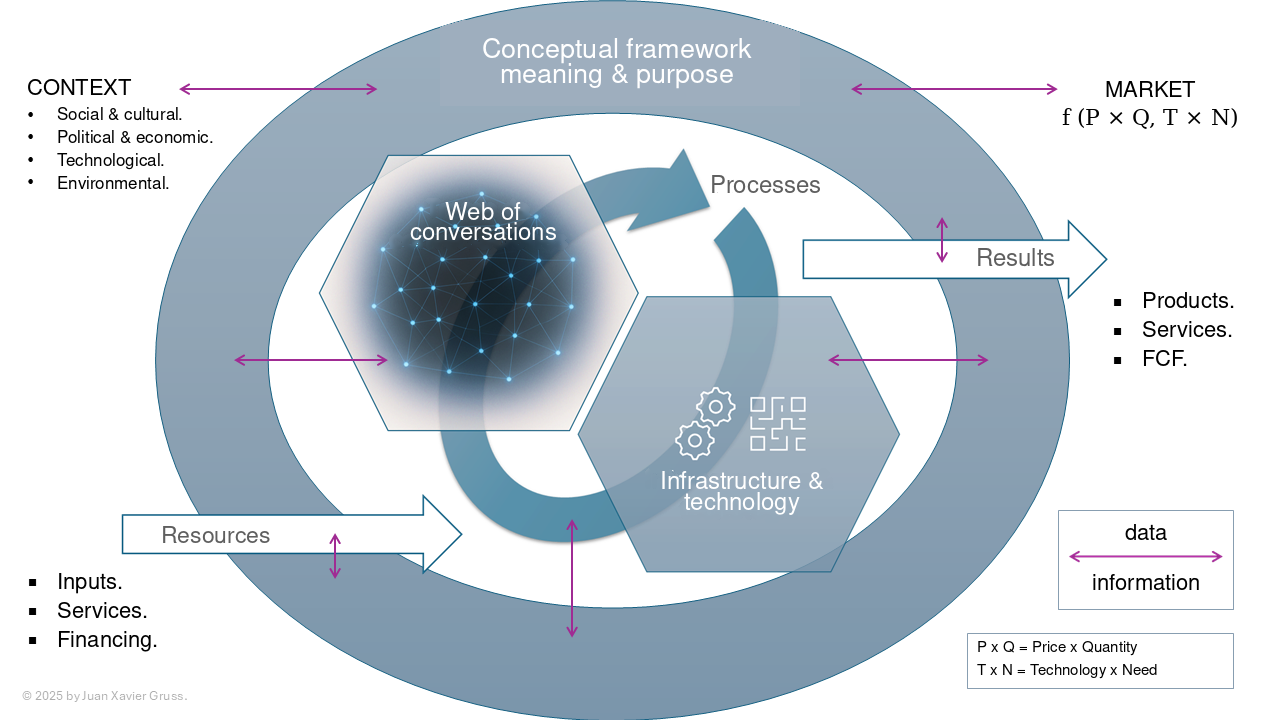
Before defining what must change, we build an integrated representation of the current situation. We connect actors, conversations, decisions, tensions, dependencies and patterns of operation to understand how the observed results are produced and which conditions sustain the problem.

The Systemic Map organizes the evidence and allows people to discuss the same reality without reducing it to isolated functions, individuals or symptoms. It is neither an org chart nor a static description. It is a visual, revisable hypothesis about how the organization works, intended to improve the quality of diagnosis and indicate where intervention is most useful.

The Systemic Map describes and explains how the current situation works. The Transition Map builds on that diagnosis to specify the desired state, the conditions of passage and the decisions needed to move through it. The two instruments are related, but they serve different purposes and must not be presented as synonyms.

Systemic Map and Transition Map

Conceptual map of organizational dynamics connecting context, purpose, conversations, processes, infrastructure, inputs and outcomes

Organizational dynamics · Open the full-size image

01

Define.

We separate the visible phenomenon from the logic that is actually changing. Naming the episode is not yet the same as understanding the transition.

02

Test.

We gather accounts, documents, indicators, metrics and critical episodes. We look for convergence, contradiction, anomalies and gaps in information.

03

Build a hypothesis.

We integrate the evidence to explain what has stopped working, why, and with what consequences. The hypothesis must be open to challenge, revision and decision.

04

Decide what must change.

We distinguish what can be corrected locally from what requires changes to rules, responsibilities, capabilities or leadership criteria.

05

Design and lead.

We define governance, decision rights, priorities, responsibilities, forums, rhythms, indicators and learning mechanisms, then test them in real situations.

06

Transfer and consolidate.

We verify that the new way of operating can endure beyond the extraordinary intervention, correct deviations, and transfer capabilities and authority.

THE POINT OF ENTRY

Not every situation starts in the same place.

The initial situation determines the first solution. The way we participate is agreed afterwards, according to the authority, executive capacity and continuity the situation requires.

The challenge is diffuse or contested.

We begin with a Transition Map to build a shared hypothesis.

A hypothesis exists, but the new operating regime is not yet working.

We begin with Transition Activation to design it and put it into practice.

The organization does not yet exist.

We begin with Organizational Genesis to turn the initiative into a system capable of operating.

We confirm the point of entry after the initial conversation. There is no need to choose a service before we talk.

SOLUTIONS

Three concrete outcomes for different moments.

Each solution has a starting point, an expected outcome and an indicative duration. We confirm the final scope after defining the situation.

When it fits

The challenge is diffuse, spans several functions, or produces competing explanations. There are symptoms and urgency, but no shared hypothesis yet about what is happening or how deep the required change may be.

What we do

We combine 8 to 12 interviews with analysis of documents, indicators, metrics and critical episodes. We map actors, decisions and conversations; identify convergence, contradictions and blockages; and formulate an integrated hypothesis about the problem and its causes. We close with an executive workshop to agree what can be corrected locally, what requires a broader transition and which decision should come next.

What remains in place

A Transition Map, the evidence that supports it, a prioritized hypothesis, intervention options and an agreed next decision. The map is neither an org chart nor a project plan. It represents the starting state, the desired state and the conditions that determine the passage between them.

Indicative duration

4–8 weeks. Duration depends on scope, the number and availability of participants, and access to relevant information.

When it fits

There is a shared working hypothesis, but the new way of operating has not yet been defined or cannot be sustained. The challenge is no longer only to understand: it is to translate the hypothesis into decisions, practices and execution capacity.

What we do

We define transition governance, decision rights and levels, priorities, responsibilities, coordination forums, management rhythms and the necessary indicators. We support implementation through work on real situations, follow-up and course correction. We conduct reviews at 30, 60 and 90 days to assess progress, remove obstacles and consolidate learning.

What remains in place

A functioning management regime: clear decisions and responsibilities, a cadence of implementation and follow-up, coordination forums, a management dashboard and mechanisms to review and correct course.

Indicative duration

12–24 weeks. Duration depends on the depth and scope of the transition and on the internal capacity available to sustain it.

When it fits

An idea, initiative or project needs an organizational existence of its own: a new venture, a spin-off, a business unit, or an initiative that can no longer be sustained as an informal effort.

What we do

We start with a business hypothesis that can be tested. We clarify purpose, value proposition and business model; define boundaries and priorities; identify critical resources and capabilities; design roles and responsibilities; establish mechanisms for decision-making, coordination and exchange; and put in place metrics, cadences and an initial operating model. The design is adjusted through real operating experience.

What remains in place

A minimum viable organization with structure, responsibilities, management practices and the effective capacity to begin operating, learning and evolving.

Indicative duration

6–9 months. Duration depends on the maturity of the hypothesis, available resources, external dependencies and the speed of validation.

Scope note

The engagement focuses on the organizational and leadership system. Legal, accounting, investment, recruitment, product development or commercial execution services are included only when expressly agreed and delivered with the relevant specialists.

WAYS OF PARTICIPATING

The solution defines the outcome; the mode of participation defines the role we assume.

The same transition may require external judgement, temporary executive leadership, or continuity within a governing body. The mandate is explicitly defined before work begins.

When it fits

The owner, board or executive team needs to analyse situations, test judgement, prepare decisions and sustain follow-up while retaining full leadership authority and responsibility.

What we do

We maintain a regular working session with preparation beforehand and follow-up afterwards. When the situation requires it, we add sessions with the leadership team and limited availability for critical matters agreed in advance. Each cycle orders the agenda, makes criteria explicit, records commitments and reviews the effects of decisions.

What remains in place

A prioritized agenda, clearer decision criteria, visible commitments and pending matters, and a follow-up discipline capable of turning reflection into action.

Indicative duration

Recommended minimum: 3 months. Frequency and commitment are agreed according to the agenda and the level of support required.

When it fits

Executive capacity is missing, a critical role is vacant, or the change requires a cross-functional leader with effective authority. The organization needs more than recommendations: it needs leadership and execution.

What we do

We assume an explicit executive mandate with agreed authority, scope, objectives, commitment and reporting relationships. We lead the agenda, coordinate the team, make or facilitate priority decisions and install a management dashboard. From the outset, we plan the transfer of capabilities, outstanding matters and authority to the permanent organization.

What remains in place

Decisions made and put into practice, a functioning execution rhythm, clear priorities and responsibilities, visible progress and an orderly transfer to the permanent team or successor.

Indicative duration

From 3 months. Fractional leadership involves a recurring part-time commitment; interim leadership temporarily fills a role until it is stabilized or transferred.

When it fits

A board or advisory council needs independent judgement, executive experience and sustained follow-up without replacing the executive line.

What we do

We prepare for and participate in regular meetings, review management information, discuss priorities, risks and significant decisions, and follow up on agreed commitments. The mandate may include limited extraordinary sessions for critical matters.

What remains in place

A structured governance agenda, better criteria for decision-making, traceable follow-up and a regular assessment of how the governing body works and contributes.

Indicative duration

Recommended minimum: 6 months. The usual frequency is monthly, with extraordinary sessions defined in advance.

LET’S START WITH THE REAL PROBLEM

The first conversation does not require choosing a service.

It helps define the challenge, assess its depth and determine whether we can contribute. No prefabricated diagnoses and no premature commitments.