Power
Who decides, with what legitimacy, within what limits and time horizon.
 JXGEstrategia de Negocios & Operaciones
“Our purpose is to help understand, decide, and act.
We offer perspective, focus, and experienced management capacity.”
JXGEstrategia de Negocios & OperacionesDiagnosis · Design · Leadership

We work with owners, boards and leadership teams on concrete business and organizational challenges. We combine a systemic perspective with a commitment to transformation to develop capabilities and improve how organizations decide, coordinate, create value and learn.
Intelligence. Legitimacy. Capacity to learn.
Management solutions
We start with specific needs to develop capabilities and improve how the organization decides, coordinates and creates value. Diagnosis helps us agree whether the challenge calls for a focused intervention or a broader transformation.
Guiding thesis
Our systemic perspective connects people, decisions, processes, resources and context. Our focus on transformation directs the work toward changes that become embedded in the organization’s capacity to function.
A specific challenge may call for a focused improvement or a broader transformation. When operating patterns change, we examine their effects across five constitutive domains.
Explore the taxonomy of changeWho decides, with what legitimacy, within what limits and time horizon.
How the organization creates, delivers, and captures value.
How it distributes decisions, commitments, and interdependencies.
How it learns, interprets, and turns capabilities into action.
What it regards as valid, its own, valuable, and tolerable.
Signals that warrant opening a diagnosis
Meetings confirm more than they explore, and error stops producing understanding.
Silence, escalation, self-protection, and the cost of speaking truthfully all increase.
The dashboard shows order while fatigue, cynicism, or loss of initiative grow.
Over-optimization eliminates useful variation, redundancy, local judgment, and experimentation.
Formal compliance grows, but so do rework, delays, and poorly resolved exceptions.
Some people permanently compensate for gaps in design, coordination, or capability.
Discourse and experience come apart; formal adherence survives without real commitment.
A single language explains everything, dissent loses ground, and data confirm decisions already made.
We do not read isolated symptoms or linear relationships: we look for constellations of converging evidence that reveal a loss of adaptive capacity, coordination, learning, or legitimacy.
Do you recognize several of these signals?
An initial conversation helps us understand the challenge and its context, test interpretations and agree on the depth of the intervention.
Operational taxonomy
The taxonomy is a revisable map, not a dogma. It brings order to reality without claiming to exhaust it and avoids calling every visible change a “transformation.”
This framework helps distinguish what changes in a transformation. It guides the analysis and complements the management solutions.
Power, time horizon, and arbitration
Authority, judgment, and accountability
Value creation and capture
Architecture of coordination
Operational memory and variability
Work, data, and decision latency
Knowledge and execution capability
Meaning, tacit norms, and belonging
Dependencies and extended coordination
Capital, cash, return, and temporality
From diffuse possibility to an emerging system
Each case is framed through one primary family and no more than two secondary ones. If everything fits into everything else, the classification loses analytical edge.
O1 · O2 · O3 · OF
Adjustment, change in logic, reframing, or foundational creation.
CT · EP · PE
Continuous, episodic, or through punctuated equilibrium.
D · E · F
Designed, emergent, or forced by crisis or constraint.
L · X · C · S
Local, cross-functional, corporate, or systemic/ecosystem-wide.
HOW WE WORK
We combine diagnosis, design and leadership according to the challenge. We work on projects, advise leaders, assume executive responsibilities or participate in boards and advisory councils, with an agreed scope and mandate.
Learn how we workSYSTEMIC MAP
We build a shared representation of the organization that connects actors, conversations, decisions, tensions and patterns of operation. The Systemic Map distinguishes symptoms from the logic that produces them and identifies where an intervention can have meaningful effects.
See how we build the map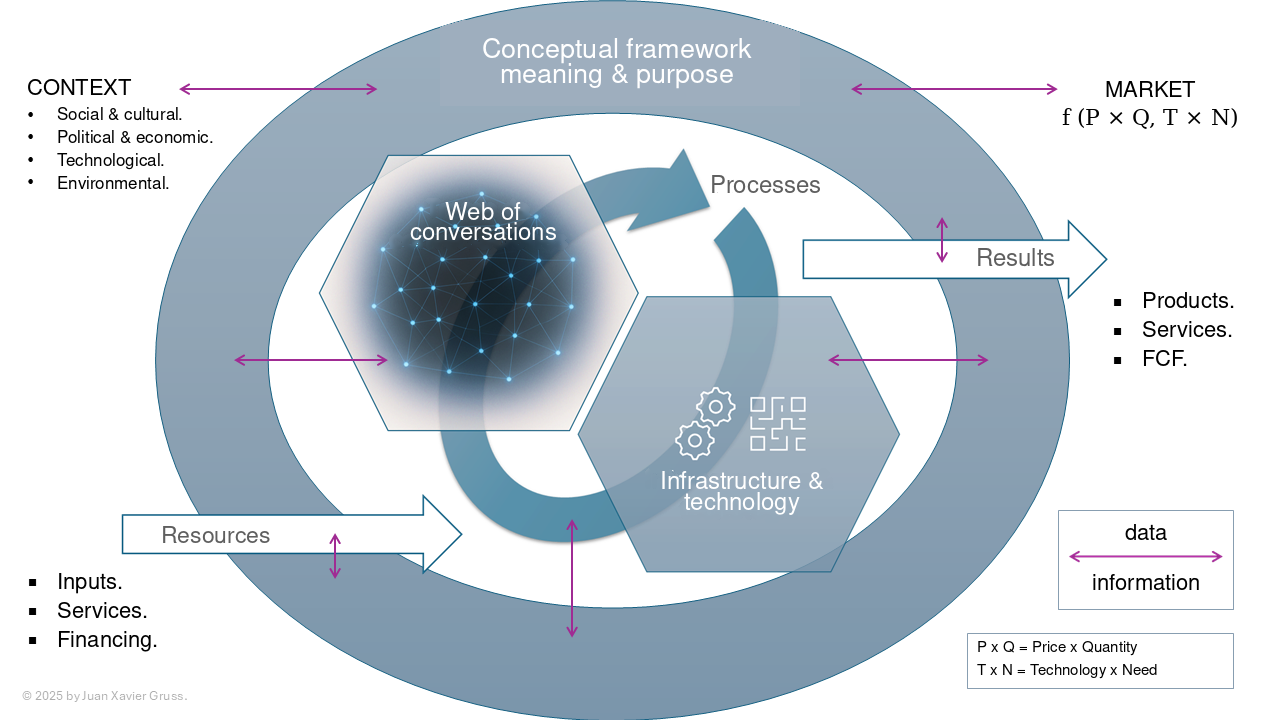
Organizational dynamics · Open the full-size image
Integrative leadership
It is about strengthening the collective capacity to inhabit it, test interpretations, and learn before accumulated fragility becomes rupture.
Expertise lies not only in a toolkit, but in a perspective capable of designing conditions: limits and freedoms, processes and judgment, metrics and conversations, governance and legitimacy.
One practice, five functions
Leadership is not reducible to a personal style. It combines purpose, expansion, structuring, analytical clarity, and repair according to what the system needs at each moment.
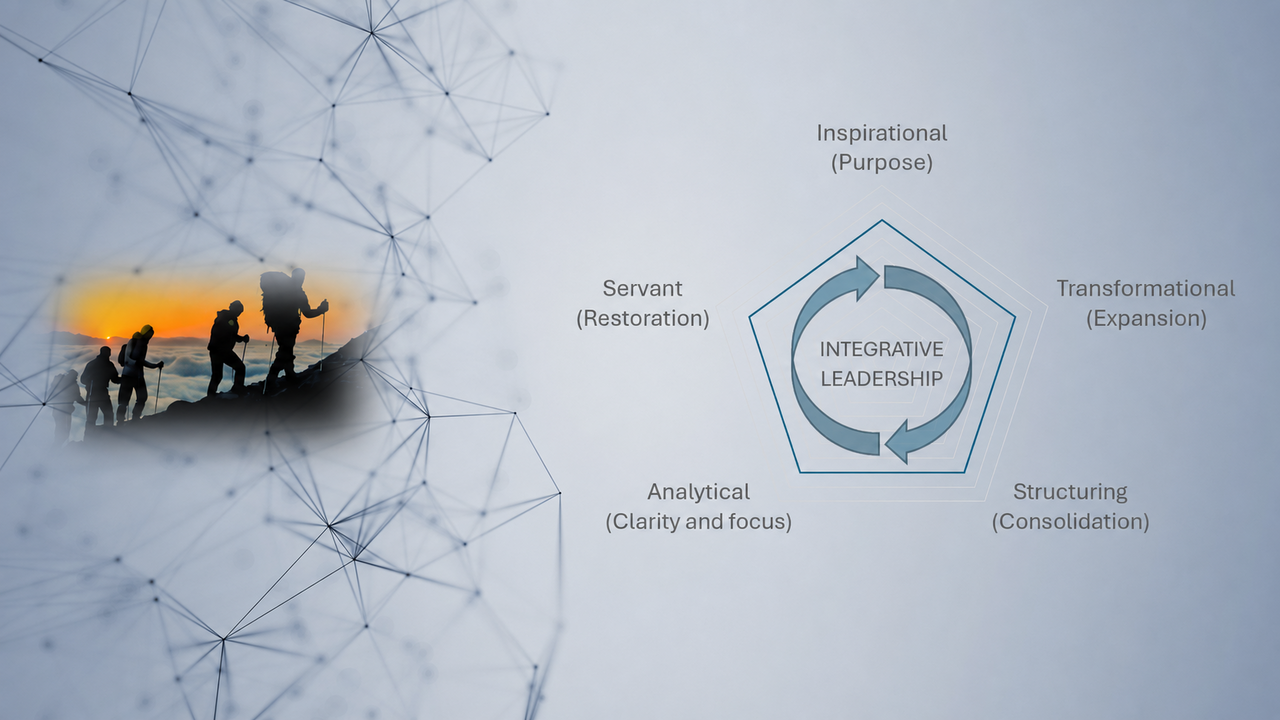
Integrative leadership · Open the full-size image
Renew meaning and direction without empty grand narratives.
Challenge inertia, open up the future, and mobilize the passage.
Provide form, roles, limits, and supports that can sustain it.
Read signals, data, and frames with clarity and humility.
Restore trust, conversations, and operational dignity in service of the system.
Cognitive and epistemic humility · Adaptive plasticity · Protection of reasoned dissent · Management of power and ego · Legitimacy as coherence · Tolerance for ambiguity
Let’s begin by understanding the challenge and its context
If you want to strengthen your organization, develop an initiative or lead a transformation, let’s talk. An initial conversation helps define the challenge and assess how we can contribute.
Buenos Aires · We work with organizations in Argentina and other markets.